A practical guide to understanding the CSR role and its impact on business success
Introduction
In today’s highly competitive business environment, customer experience has become one of the most decisive factors in a company’s success or failure. Businesses are no longer competing only on product quality or pricing. They are competing on the quality of every interaction a customer has with them.
This is where the Customer Service Representative (CSR) becomes indispensable. A CSR is the person who communicates directly with customers, listens to their concerns, solves their problems, and ensures they leave each interaction with a positive impression of the company.
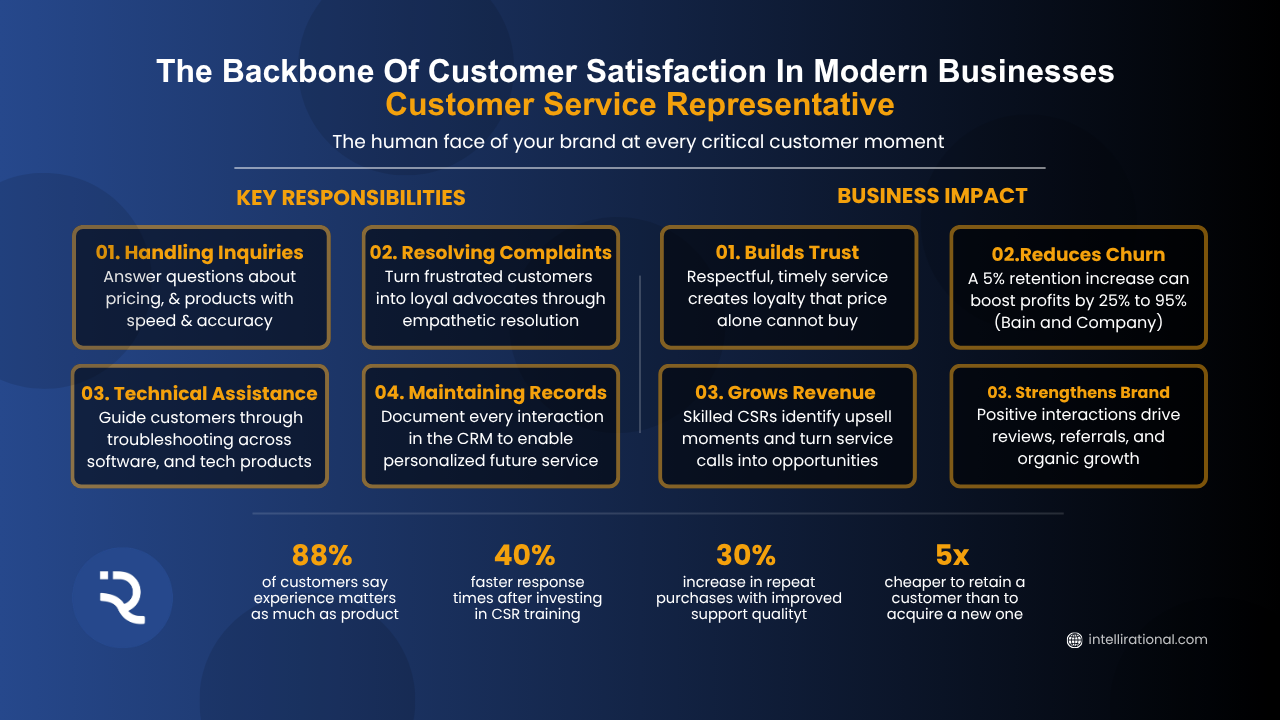
According to a 2024 Salesforce State of Service report, 88% of customers say the experience a company provides is as important as its products or services. That is a direct reflection of what CSRs do every day. A strong customer service team can transform a frustrated customer into a loyal brand advocate. Companies that invest in professional, well-trained CSRs consistently outperform competitors in customer retention, brand trust, and long-term revenue growth.
This guide explores the CSR role in depth: what it involves, why it matters, what skills it requires, and where it is heading in 2026 and beyond.
What is a Customer Service Representative (CSR)?
A Customer Service Representative is a professional responsible for assisting customers by answering questions, resolving complaints, processing requests, and providing accurate information about products or services. CSRs serve as the primary communication bridge between a company and its customers.
In 2026, CSRs interact with customers across a wider range of channels than ever before, including:
- Phone calls and video support
- Email correspondence
- Live chat on websites and mobile apps
- Social media platforms (direct messages, comments, and mentions)
- Help desk and ticketing systems
- In-app support integrated into software products
The ability to operate effectively across all of these channels, while maintaining a consistent tone and quality of service, is what defines a modern CSR.
The core objective remains simple: ensure customers receive fast, accurate, and helpful support whenever they need it.
Why Customer Service is Critical for Business Success
Customer service is one of the most powerful levers a business can use to drive growth. Its impact goes well beyond solving individual problems. Each positive interaction builds a relationship; each negative one risks losing a customer permanently.
Here are the four key reasons why customer service directly affects business outcomes:
1. Builds Customer Trust
When customers receive helpful, respectful, and timely service, they develop trust in the brand. Trust is the foundation of long-term customer relationships. A customer who trusts a company is far less likely to defect to a competitor, even when prices are lower elsewhere.
2. Strengthens Brand Reputation
In the age of online reviews and social media, customer service experiences travel fast. A single positive interaction can generate a five-star review or a referral. A single negative one can go viral. Companies with a reputation for excellent service attract customers organically, reducing the cost of acquisition.
3. Increases Customer Retention
Retaining an existing customer costs significantly less than acquiring a new one. Research from Bain and Company suggests that increasing customer retention rates by just 5% can increase profits by 25% to 95%. Good customer service is the single most effective driver of retention because it directly addresses why customers leave: feeling ignored, undervalued, or poorly supported.
4. Creates Upsell and Growth Opportunities
CSRs who build genuine rapport with customers are well-positioned to identify upsell and cross-sell opportunities. A customer calling about a billing issue might be receptive to a plan upgrade if the CSR resolves the issue smoothly and positions the offer at the right moment. This turns service interactions into revenue opportunities.
Key Responsibilities of a Customer Service Representative
The day-to-day responsibilities of a CSR are broad and require a combination of people skills, technical knowledge, and sound judgment. Here are the five core responsibilities:
1. Handling Customer Inquiries
Customers contact companies daily with questions about pricing, product details, service policies, account information, and order status. CSRs must be able to provide accurate, clear answers quickly. A slow or inaccurate response damages the customer’s confidence in the company.
Practical tip: CSRs should maintain access to an up-to-date internal knowledge base so they can retrieve accurate answers without putting customers on hold unnecessarily.
2. Resolving Customer Complaints
Complaint resolution is arguably the most important CSR function. Customers who feel their complaints are handled well are often more loyal than customers who never complained at all. A skilled CSR listens carefully, acknowledges the issue, and works toward a resolution that the customer considers fair.
Effective complaint resolution requires empathy, patience, product knowledge, and the authority or judgment to offer appropriate remedies such as refunds, replacements, or escalations.
3. Processing Orders and Account Requests
CSRs frequently assist customers with placing or modifying orders, updating account information, managing subscriptions, and tracking deliveries. Accuracy is essential here. An error in processing can create a cascade of follow-up issues that damage the customer relationship and increase the team’s workload.
4. Providing Technical Assistance
In industries such as software, telecommunications, fintech, and consumer electronics, CSRs are often the first line of technical support. They guide customers through troubleshooting steps, configuration issues, and common error resolutions. In 2026, this increasingly involves helping customers navigate AI-powered or app-based products, which requires CSRs to stay technically current.
5. Maintaining Accurate Customer Records
Every customer interaction should be documented in the company’s CRM system. Accurate records allow the team to track recurring issues, provide personalized service, and identify patterns that can inform product improvements. A CSR who documents interactions thoroughly makes the entire support operation more effective.
Essential Skills Every CSR Should Have
Becoming a high-performing CSR requires a blend of interpersonal abilities and practical knowledge. The following skills are the foundation of excellent customer service:
Communication Skills
Clear, professional, and channel-appropriate communication is the baseline requirement for any CSR. This means adapting tone and style depending on whether the interaction is a phone call (warm and conversational), an email (thorough and precise), or a live chat (concise and fast). Customers should always feel that the person they are speaking with is confident, competent, and genuinely helpful.
Problem-Solving Ability
Most customers contact support because something has gone wrong. A CSR must be able to quickly analyze the situation, identify the root cause of the issue, and offer a practical solution. This requires critical thinking, familiarity with company policies, and the confidence to make decisions under time pressure.
Patience and Empathy
Some customers are frustrated, upset, or even hostile when they reach out. A professional CSR remains calm, avoids reacting emotionally, and approaches every interaction with genuine empathy. Acknowledging a customer’s frustration before jumping to a solution can defuse tension and create a far more productive conversation.
Time Management
Customer service teams handle large volumes of requests simultaneously. CSRs must be able to prioritize urgent or escalated cases, manage response times, and keep interactions focused without rushing customers. Poor time management leads to SLA breaches, backlogs, and deteriorating service quality across the board.
Product and Service Knowledge
A CSR who does not know the product cannot serve the customer effectively. Deep, current product knowledge enables CSRs to answer questions accurately, troubleshoot confidently, and identify the right solution without escalating unnecessarily. In fast-moving industries, this means regularly reviewing product updates, policy changes, and release notes.
Technical Proficiency
Modern customer service relies on technology. CSRs are expected to be proficient in CRM platforms (such as Salesforce or HubSpot), ticketing systems (such as Zendesk or Freshdesk), live chat tools, and increasingly, AI-assisted response platforms. Technical fluency allows CSRs to work faster, track interactions more accurately, and deliver a more consistent experience.
The Business Benefits of a Strong Customer Service Team
Investing in a well-trained customer service team delivers measurable returns across multiple areas of the business:
- Higher customer satisfaction scores (CSAT), which correlate directly with retention and revenue
- Stronger brand reputation driven by positive reviews, referrals, and social proof
- Reduced churn, as customers who feel well-supported are significantly less likely to leave
- Increased lifetime customer value through upselling, cross-selling, and repeat purchases
- Valuable product feedback, since CSRs hear directly about pain points, bugs, and feature requests that product teams can act on
Customer service is not a cost to be minimized. It is an investment that compounds over time.
Case Study: How Customer Service Drove Business Growth
A growing e-commerce company was experiencing a surge in customer complaints stemming from slow support response times. Customers were waiting three to five days for replies to basic order and refund queries, which was generating a wave of negative reviews and increasing the rate of customer churn.
The company took two actions. First, it invested in training its Customer Service Representatives in communication, complaint resolution, and product knowledge. Second, it implemented a modern help desk platform with automated ticket routing and priority queuing.
Within six months, the results were significant:
- Average response time improved by 40%, dropping from over three days to under four hours
- Customer satisfaction (CSAT) scores increased by 28%
- Repeat purchase rate increased by nearly 30%
- Volume of negative online reviews decreased by over half
- Support team capacity improved without increasing headcount, due to better tooling and training
This case illustrates a principle that applies across industries: the quality of your customer service operation is a direct input to your business results. It is not a background function. It is a growth lever.
The Future of Customer Service in 2026 and Beyond
Customer service is undergoing a significant transformation driven by artificial intelligence, automation, and evolving customer expectations. Understanding these shifts is essential for any business that wants its customer service team to remain competitive.
AI and Automation Are Handling the Routine
AI-powered chatbots and virtual assistants are now capable of handling a growing share of routine customer queries: order tracking, FAQs, password resets, and basic troubleshooting. Platforms like Intercom, Zendesk AI, and Salesforce Einstein are embedding these capabilities directly into support workflows.
This means the volume of simple queries reaching human CSRs is decreasing. What remains is more complex: nuanced complaints, emotionally sensitive situations, edge cases, and multi-step problems that require genuine human judgment.
Human Skills Become More Valuable, Not Less
As automation handles the routine, the human CSR’s role becomes more specialized. Skills such as emotional intelligence, de-escalation, empathy, and creative problem-solving become more important precisely because they are the things AI cannot replicate reliably.
Customers who have already exhausted a chatbot and escalated to a human agent arrive with higher expectations and lower patience. A CSR who can meet that moment effectively is extremely valuable.
Omnichannel Service is Now the Standard
Customers in 2026 expect to be able to start a conversation on one channel and continue it on another without repeating themselves. A customer might open a chat, follow up via email, and call the next day. The CSR they speak to should have full context of the interaction history.
This requires modern CRM systems that unify interaction history across channels, and CSRs who are trained to use them. Omnichannel fluency is no longer a premium capability. It is the baseline expectation.
Conclusion
Customer Service Representatives are not just support staff. They are the human face of a brand at the moments that matter most: when a customer has a problem, a question, or a complaint. How those moments are handled determines whether customers stay or leave, recommend or warn others, and grow in value or churn.
Companies that treat customer service as a strategic function, rather than an operational cost, consistently outperform those that do not. They build stronger customer relationships, generate more organic growth through referrals, and create resilient brands that withstand competitive pressure.
As technology continues to evolve, the CSR role will evolve with it. Automation will handle more of the routine. Human CSRs will handle more of the complex and emotional. The organizations that invest in training their teams for both realities will be the ones that thrive.
Excellent customer service is not just about solving problems. It is about building trust, creating loyalty, and turning customers into advocates. That is not a support function. That is a growth strategy.