Complete Guide 2026
Intelli-Rational Solutions | April 2026
Introduction
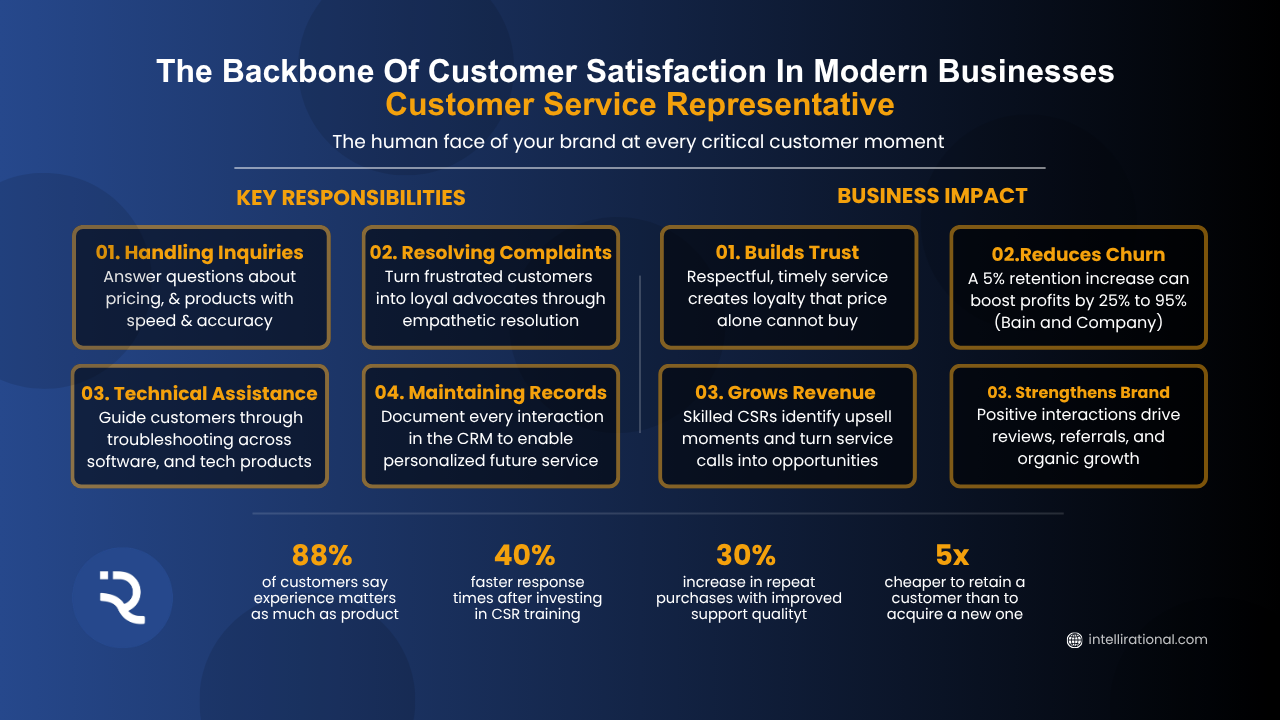
Customer service plays a crucial role in building strong relationships between businesses and their customers. In today’s competitive market, companies do not only compete on products or pricing. They compete on the quality of the experience they provide.
A Customer Service Representative (CSR) is often the first point of contact between a company and its customers. The way a CSR communicates, solves problems, and handles customer concerns can directly impact customer satisfaction and brand reputation.
In 2026, customer service is evolving rapidly. AI-powered chatbots handle routine queries, omnichannel support spans phone, email, live chat, and social media, and customers expect faster and more personalized resolutions than ever before. This means CSRs must develop a combination of timeless human skills and modern technical abilities to stay effective and relevant.
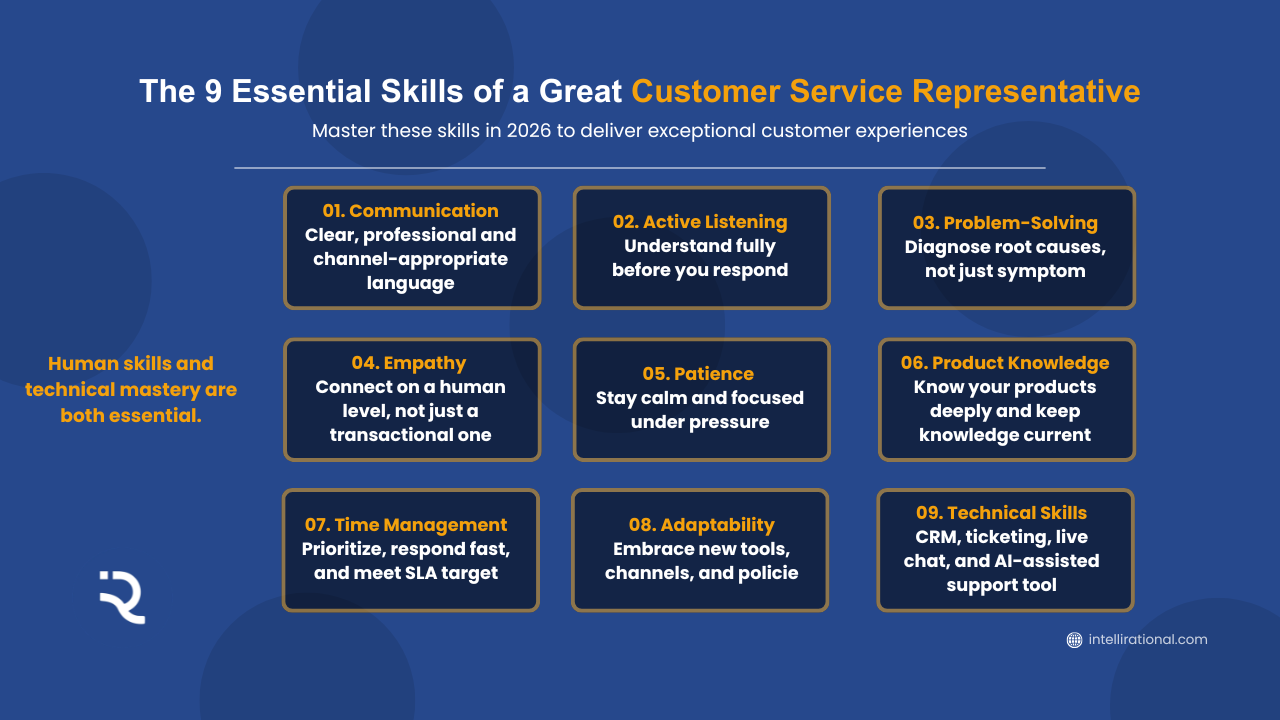
In this guide, we explore the 9 most important skills every Customer Service Representative must have in 2026, with practical examples and actionable tips for each.
1. Communication Skills
Communication is the foundation of customer service. A CSR must be able to communicate clearly, politely, and professionally across multiple channels: voice calls, emails, live chat, and social media.
Customers often reach out when they are confused, frustrated, or facing a problem. In such situations, the CSR must explain solutions in a simple and understandable way, adapting their tone to the channel and context.
Strong communication skills include:
- Clear and professional language suited to each channel (formal for email, conversational for chat)
- Active listening before forming a response
- Proper tone: warm on calls, concise in chat, thorough in email
- Confidence while explaining solutions without sounding dismissive
Practical tip: Record and review a sample of your calls monthly. Identify filler words, interruptions, or unclear explanations and work to eliminate them.
When communication is effective, customers feel heard and valued, which improves their overall experience.
2. Active Listening
Listening is just as important as speaking in customer service. Many customer issues go unresolved because representatives rush to provide solutions without fully understanding the problem.
Active listening means giving the customer your full attention, processing what they say, and demonstrating understanding before you respond.
Active listening involves:
- Paying full attention and avoiding multitasking during the interaction
- Avoiding interruptions; let the customer finish before you speak
- Asking clarifying questions to surface the real issue
- Repeating key points back to confirm understanding
Practical tip: After the customer explains their issue, try summarizing it: “So if I understand correctly, you’re experiencing X and you’d like Y. Is that right?” This prevents misunderstandings and shows the customer you are engaged.
When customers feel genuinely listened to, their frustration often decreases significantly, even before the issue is resolved.
3. Problem-Solving Ability
Customers almost always contact support because something has gone wrong. Problem-solving is therefore at the heart of the CSR role. A skilled CSR must quickly analyze the situation, identify the root cause, and offer a suitable resolution.
Good problem-solving requires:
- Critical thinking to diagnose the issue, not just treat the symptom
- Quick decision-making within company guidelines
- Understanding company policies and knowing when exceptions can be made
- Offering alternative solutions when the ideal resolution is not available
Real scenario: A customer’s replacement order was lost in transit. Rather than simply reopening a ticket, a skilled CSR checks the courier tracking, identifies the last known location, escalates to the logistics team, and simultaneously offers the customer a voucher as goodwill. This resolves both the practical and emotional aspects of the complaint.
Companies value CSRs who can solve issues efficiently while keeping customers satisfied, not just those who follow scripts.
4. Patience and Emotional Control
Customer service is emotionally demanding. CSRs regularly deal with frustrated, angry, or distressed customers who may direct negative emotions at the representative personally.
A professional CSR must:
- Stay calm under pressure and not take hostile language personally
- Avoid reacting emotionally or escalating the tension
- Maintain a polite, steady tone regardless of how the customer behaves
- Focus on resolving the issue rather than winning the interaction
Practical tip: Use the pause and breathe technique before responding to an angry customer. A two-second pause prevents knee-jerk reactions and signals to the customer that you are thinking carefully rather than responding defensively.
Handling difficult customers with patience often turns negative experiences into positive ones, and sometimes turns complainers into loyal advocates.
5. Empathy
Empathy is the ability to understand and share the feelings of another person. It is one of the most powerful tools a CSR can have, and it is what separates transactional support from genuinely human service.
In customer service, empathy allows a CSR to connect with customers on a human level. When customers feel that the representative truly understands their frustration, they become more cooperative and more willing to accept solutions.
Empathy in practice looks like:
- Acknowledging the customer’s frustration before jumping to a fix
- Using first-person language: “I understand how frustrating that must be”
- Avoiding scripted or robotic-sounding responses
- Showing genuine interest in resolving the issue, not just closing the ticket
A simple acknowledgment such as “I understand how frustrating this situation must be for you. Let me help you resolve it as quickly as possible” can significantly improve customer satisfaction and de-escalate tension.
6. Product and Service Knowledge
A CSR cannot help customers effectively without a deep, up-to-date understanding of the company’s products or services. Customers expect accurate information and quick solutions, not uncertainty.
CSRs must stay current on:
- Product features, configurations, and known limitations
- Pricing, packages, and promotional offers
- Company policies on returns, refunds, warranties, and SLAs
- Troubleshooting procedures and known issue workarounds
2026 context: As product lines expand and update more rapidly, CSRs should use internal knowledge base tools and AI-assisted search to surface accurate information in real time during interactions.
The more knowledgeable a CSR is, the faster they can solve customer problems and the more confident they sound doing it.
7. Time Management
Customer service representatives often handle multiple tasks simultaneously: answering calls, responding to emails, managing live chats, and updating records. Effective time management is essential to maintaining quality across all interactions.
Effective time management for CSRs includes:
- Prioritizing urgent or escalated requests over routine ones
- Managing response times and meeting SLA targets
- Keeping conversations focused and on-track without rushing customers
- Batching similar tasks (e.g., email replies) to minimize context-switching
Efficient time management improves both productivity and customer satisfaction. Customers appreciate fast responses, and well-managed queues reduce team burnout.
8. Adaptability
Customer service environments change quickly. In 2026, new AI tools, updated CRM platforms, shifting company policies, and evolving customer expectations mean CSRs must be comfortable with constant change.
Adaptability includes:
- Learning new software tools and CRM updates with minimal disruption
- Adjusting to company policy changes and communicating them accurately to customers
- Handling a wide range of customer personalities and communication styles
- Working effectively across new channels such as social media DMs or in-app support
2026 context: CSRs who embrace AI-assisted tools such as real-time response suggestions and automated ticket categorization will handle higher volumes without sacrificing quality. Resistance to new tools, on the other hand, is increasingly a liability.
Flexible, adaptable employees are more valuable to companies because they can absorb change without performance degradation.
9. Technical Skills
Modern customer service relies heavily on technology. CSRs routinely use CRM systems, help desk platforms, live chat tools, ticketing software, and increasingly, AI-assisted support tools.
Common tools used by CSRs in 2026:
- CRM software (e.g., Salesforce, HubSpot, Zoho CRM)
- Live chat and messaging platforms (e.g., Intercom, Zendesk Chat)
- Email support platforms (e.g., Front, Help Scout)
- Customer ticketing systems (e.g., Zendesk, Freshdesk, Jira Service Management)
- AI-assisted response tools and knowledge base platforms
Understanding these tools helps CSRs track issues, maintain accurate records, and improve overall service quality. Proficiency in the core platforms used by your employer is now a baseline expectation, not a bonus skill.
Case Study: How Skilled CSRs Improve Customer Experience
A mid-sized SaaS company noticed a pattern: customers were leaving negative reviews citing slow responses and unresolved technical issues. Despite having a solid product, the support experience was the weak link.
To address this, the company ran a 90-day CSR training programme focused on three areas: structured communication frameworks, empathy training, and hands-on product knowledge sessions.
Within four months, the company measured:
- Customer satisfaction (CSAT) score increased by 35%
- First contact resolution (FCR) rate improved by 28%
- Average handling time reduced by 20% due to better product knowledge
- Customer complaints decreased by over 40%
- Customer retention increased measurably quarter-over-quarter
This illustrates a key principle: technical product quality and human service quality must both be strong. Skilled CSRs are not a cost centre. They are a growth driver.
The Future of CSR Skills in 2026 and Beyond
Customer service is evolving rapidly. AI, automation, and advanced CRM systems are transforming how support is delivered. Routine queries such as order tracking, password resets, and basic FAQs are increasingly handled by bots.
This shift means the CSR’s role is becoming more complex, not less important. The interactions that reach a human CSR are increasingly the difficult ones: emotionally charged complaints, complex multi-step problems, and situations that require genuine judgment and empathy.
Skills that will grow in importance:
- Emotional intelligence and de-escalation in an era of bot fatigue
- Cross-channel fluency as customer journeys span more touchpoints
- AI tool proficiency: using AI-generated suggestions critically rather than blindly
- Data literacy: reading customer history and sentiment data to personalize service
Human skills such as empathy, communication, and problem-solving remain irreplaceable. The best CSRs in 2026 will be those who combine these human strengths with fluency in the tools that amplify them.
Conclusion
Customer Service Representatives play a vital role in shaping how customers perceive a brand. The quality of customer interactions can determine whether a customer stays loyal or switches to a competitor.
To succeed in this role, CSRs must develop a combination of soft skills (communication, empathy, patience, active listening) and hard skills (product knowledge, technical proficiency, and time management).
Businesses that invest in training their customer service teams create stronger customer relationships, improve brand reputation, and achieve long-term growth. In 2026, that investment matters more than ever: customers have more choices, higher expectations, and less tolerance for poor service.
In the modern business world, great customer service is not just support. It is a powerful and measurable growth strategy.